What Is B2B Appointment Setting? A Complete Guide for Tech Companies

If you are new to B2B sales, this guide will provide you the foundation you need to understand appointment setting and its role in generating pipeline.
The Basics of Appointment Setting
What is appointment setting?
Appointment setting is the process of contacting relevant prospects to book introductory meetings for sales reps.
The appointment setter’s goal is to generate sufficient interest from decision-makers to schedule a more detailed sales meeting with an account executive (AE). This critical function focuses on the initial prospecting and nurturing phase of top-of-the-funnel sales pipeline-building, allowing AEs to focus on developing long-term relationships and closing deals.
Why is appointment setting critical for B2B tech companies?
Selling technology solutions with high price points is characterized by:
- Large, diverse stakeholder groups; on average 13 people are involved in a buying decision, and 89% of purchases involve two or more departments (source)
- Complex buying processes
- Multiple demos, proofs of concept, and pilots required
- Long sales cycles, with 75% of B2B marketers saying that buyers are taking longer to commit to a purchase than in the past (source)
For every opportunity in the pipeline, account executives have a lot of high-value work to do—building relationships, educating prospects on their solutions, mapping challenges and requirements to product capabilities, demoing, building ROI and business cases, and more. In fact, 54% of sales professionals said selling has gotten harder than in the past because of inflation, stiff competition, a lack of high-quality leads, challenges reaching decision-makers, and longer deal cycles (source).
Appointment setting is critical because it acts as a strategic filter to ensure that sales reps focus on starting this process with viable prospects without wasting their time on cold-calling.
How is appointment setting different from prospecting?
Prospecting is the process of proactively identifying, researching, and engaging prospects for your solution, often through outreach like cold-calling. The goal is to identify and pre-qualify potential buyers. Once a prospect is deemed a good fit, appointment setting is the step to secure a specific time with a decision-maker for a first sales meeting.
Both appointment setting and prospecting are crucial top-of-the funnel activities in B2B technology sales; appointment setting is a specific step within the overall prospecting function.
Where does appointment setting fit into the B2B sales cycle?
Appointment setting sits in the middle of the B2B sales cycle, serving as a critical bridge between marketing and sales—at the point where interest from prospects is converted into a tangible commitment of time.

Here is the typical B2B sales process, with appointment setting sitting between lead generation and sales discovery:
Stage | Activity | Goal |
Early | Awareness | Ensure prospects know your solution is a viable option to address their challenge or meet their objective |
Lead generation | Capture the names and contact details of decision-makers within prospect organizations | |
Middle | Appointment setting | Get meetings with the decision-makers within prospect companies |
Discovery | Engage with prospects to diagnose their business problem before proposing a solution | |
Late | Demo/pilot | Prove the value of your solution by showing prospects the product and allowing them to “test drive” it in their own environment |
Proposal and negotiation | Close the deal |
Where does appointment setting fit into lead generation efforts?
Appointment setting is the bridge between lead generation and sales. B2B lead generation focuses on finding and attracting target personas in organizations that fit your ideal customer profile (ICP). Appointment setting is the “conversion engine” to turn that general interest into a scheduled meeting with a salesperson. Appointment setters may also do their own outbound prospecting to capture attention and secure intent with prospects that have not responded to lead generation campaigns or engaged with other marketing programs. In short, lead generation is about capturing attention, while appointment setting is about securing intent.
Who does appointment setting in B2B companies?
There are four main ways that B2B companies approach appointment setting:
- In-house inside sales: Inside sales reps (ISRs), sales development reps (SDRs), business development reps (BDRs), or lead development reps (LDRs) are responsible for setting appointments for outside reps or “closers,” who then take over the sales process.
- “Full-cycle” reps: Smaller companies or startups may have account executives (AEs) who do everything: find the lead, set the appointment, run the demo, and sign the contract.
- Outsourced appointment setting: Because of the high overhead costs of maintaining a dedicated inside sales function—which averages $85K per rep per year—many B2B technology companies choose to work with an outside partner. This could be a specialized firm (like BAO) or freelance contractors. Either way, they work as an extension of your company.
- Hybrid approach: It’s very common for B2B tech companies to use outsourced appointment setting together with an in-house approach, whether that’s inside sales or full-cycle reps. Some companies have their inside teams cover the core market while the outsourced partner prospects into other markets. Others have the outsourced appointment setters get meetings for the inside team who owns the first conversation with the prospect to qualify for opportunity before passing it on to the “closer.”
Which team in B2B tech companies owns the appointment setting function?
In B2B tech, the specific owners of the appointment setting function depends on the company’s size and lead generation/prospecting strategy. Here are the three most common approaches:
- Sales is the most common owner. Appointment setters typically report to an SDR manager or director of sales development, which come under the purview of the VP of sales or chief revenue officer (CRO).
- Marketing may own appointment setting in companies that are heavily inbound driven (i.e., most leads come from the website, content, or marketing campaigns). In this case, appointment setters likely report to an inbound SDR manager or demand gen manager, who are overseen by the VP of marketing or chief marketing officer (CMO).
- Revenue operations may own appointment setting in very mature or data-heavy tech companies. In this case, RevOps balances the needs of both marketing and sales; they manage the tools and data, which makes them efficient at managing high-volume appointment setting teams.
How many follow-up attempts does it take to book an appointment?
According to BAO internal data (2026), it takes an average of 27 dials to deliver a pitch, and 130 dials to secure one prospect meeting. These numbers will vary depending on a variety of factors. Here is the average number of dials to get a meeting by:
- Functional area
- Operations: 104
- Finance: 130
- IT: 147
- HR: 192
- Marketing: 201
- Company size
- SMB (Less than $100M revenue): 103
- Mid-market ($100M–999M revenue): 140
- Enterprise ($1B+ revenue): 153
- Industry
- Services: 111
- Transportation/utilities: 114
- Financial services: 118
- Insurance: 144
- Manufacturing: 183
- Pharmaceuticals: 199
- Retail: 217
Because it takes a lot of persistence to connect with prospects, deliver a pitch, and schedule a meeting, B2B tech companies often dedicate resources exclusively to appointment setting, with many engaging an external appointment setting partner rather than staff the function internally.
How B2B Appointment Setting Works
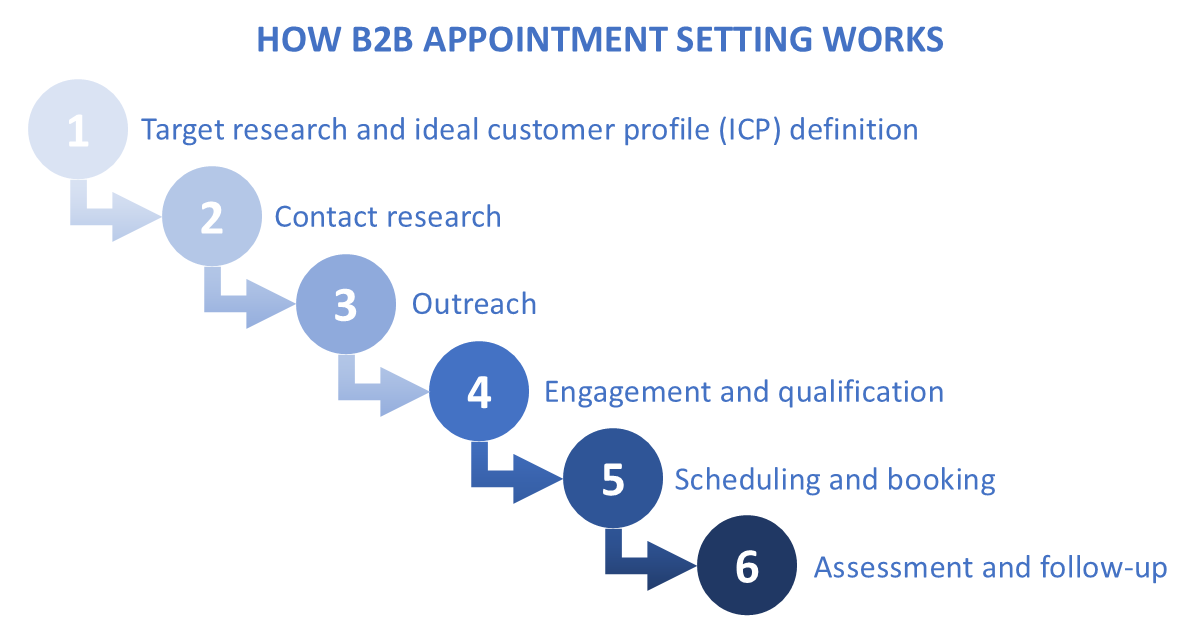
Step 1: Target research and ideal customer profile (ICP) definition
Start by defining what the ideal prospect organization looks like, which could include demographics such as size (by revenue or employee count), industry, and geography. This allows you to build a list of target companies.
If there are certain conditions that are relevant for your solution—for example, if your product requires a specific technology to be in place—that should be documented as well. This information is often not easily available for individual companies, so it may not be possible at this point to refine your target company list with this criteria.
You also want to define which roles to target, including function and seniority. These are the people that tend to be the decision-makers or influencers for solutions like yours in your target companies.
Step 2: Contact research
Next, you need to identify the specific individuals in the target roles within your target companies. You’ll need to gather their names and contact information so you can begin proactive outreach. You may have some of these contacts from inbound leads, but appointment setters can also research additional contacts to increase prospect coverage.
Step 3: Outreach
Now it’s time to establish contact with the decision-makers in the target companies. There are multiple outreach vehicles available to appointment setters in 2026—social media, email, and telephone—and each has its own advantages and challenges. The way people use a given social media platform differs from person to person, so your ability to connect may vary wildly. With email, most outreach messages get trapped in junk folders. Even when an email does get through, if it doesn’t instantly capture interest, it gets deleted. With cold-calling, many people don’t answer their phone, or have gatekeepers you need to get through. However, unlike with email, when you do get through, you have the ability to adjust your message in the moment. With B2B appointment setting outreach, persistence is the name of the game.
Step 4: Engagement and qualification
When you connect with a decision-maker, the goal isn’t to sell them the solution, it’s to assess fit (i.e., are they a good candidate to pursue), and if yes, “sell” them a first meeting with a salesperson.
Step 5: Scheduling and booking
Once the prospect agrees to take a meeting, appointment setters need to manage the logistics of scheduling and booking the meeting. It’s important to have a clear process that includes:
- Identifying everyone on the prospect’s side who should attend
- Confirming with the prospect to help reduce no-shows
- Handing over notes to the sales rep taking the meeting so they are aware of all discussions the appointment setter had with the prospect
- Handling rescheduling
Step 6: Assessment and follow-up
Tracking results at the meeting level with visibility into the quality and viability of each opportunity will help you understand the success of your overall appointment setting program.
Quality metrics include whether:
- The meeting occurred
- It was with the appropriate person
- You got a referral
- There is a scheduled second sales activity
You also need to qualify the meeting and what next steps are needed as a follow-up:
Opportunity horizon | Qualification | Next steps |
Short-term | The first meeting generated interest from the contact | Immediate follow-up activity is required to continue the sales dialog |
Short-term | The first meeting generated some interest but there are environmental, budgetary, or other requirements | Additional opportunity vetting |
Long-term | The first meeting was positive but due to existing circumstances (contract, budget, etc.) the timing is not right | Follow up in 6–12 months (for example) |
Long-term | The first meeting offered discovery and education, but the buying process is unclear | More research on the account or influencers who would be involved in the buying process |
Never | After discovery, there is no short- or long-term opportunity with this organization for your solutions | None |
Learn More about B2B Tech Appointment Setting
Now that you have the basics down, learn about choosing the right model and best practices in B2B appointment setting.
BAO Delivers Best-In-Class B2B Tech Appointment Setting Services
BAO has been setting appointments for B2B technology companies since 1997 for clients ranging from established industry titans to innovative start-ups disrupting the status quo. High-tech leaders come to BAO for performance-based appointment setting, deep expertise in the public sector, and our ability to ramp new reps fast.
Frequently Asked Questions
How does appointment setting differ from lead generation?
The goal of lead generation is to identify and attract prospects who show an initial interest in your solution, while the goal of appointment setting is to convert initial interest into a scheduled meeting with a sales rep.
Do B2B tech companies need dedicated appointment setters?
Given the complex nature and long sales cycles of B2B tech sales, most companies employ appointment setters to allow their sales reps to focus on closing deals.
Who should outsource appointment setting?
Any B2B tech company can benefit from outsourcing appointment setting, but outsourcing is particularly valuable for companies that are looking to make a fast pipeline impact, need scaling flexibility, or want lower up-front risk.
Is cold-calling still effective?
Yes—even with the advent of other outreach methods, such as email and social media, cold-calling is a real-time, high-touch engagement method that continues to be highly effective in B2B tech appointment setting.
Can appointment setting shorten my sales cycle?
By delivering introductory meetings early, appointment setting can reduce friction between interest and conversation, which can help accelerate the sales cycle.
Speak with a pipeline expert to build a program that meets your needs.